
This article will be the second of a three-part series on children’s sexual development, normal and abnormal sexual behaviors in children from pre-school to age 5. This guide is intended to help parents and caregivers:
- Gain knowledge of children’s sexual behaviors;
- Respond appropriately to a range of developmentally appropriate and inappropriate sexual behaviors;
- Determine if the child’s behavior appears to be normal curiosity or an indication that professional help should be sought.
It is normal for children under the age of 6 to behave in sexual ways. Pre-school age children are figuring out what gender they are, and because of this developmental stage in their lives, some are very curious about private parts. However, some sexual behavior in children may be an indication that there is something wrong – that the child has been sexually molested, has been exposed prematurely to adult sexual knowledge, or has begun to use sexual behavior as a way to get emotional needs met, etc. It is important to keep in mind that there are no absolutes. Normal, healthy behavior covers a wide range and may not be expressed the same, or to the same extent, in every child. Similarly, problem behavior covers a range from less to more severe, and may not mean the same thing in every child.
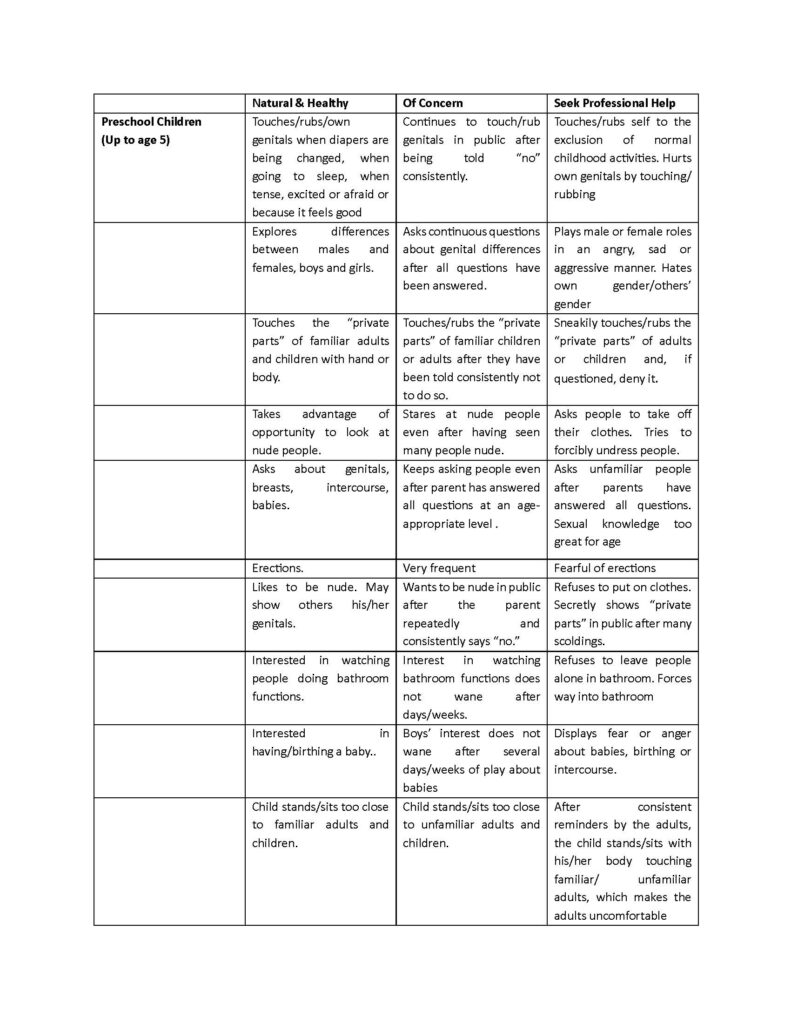
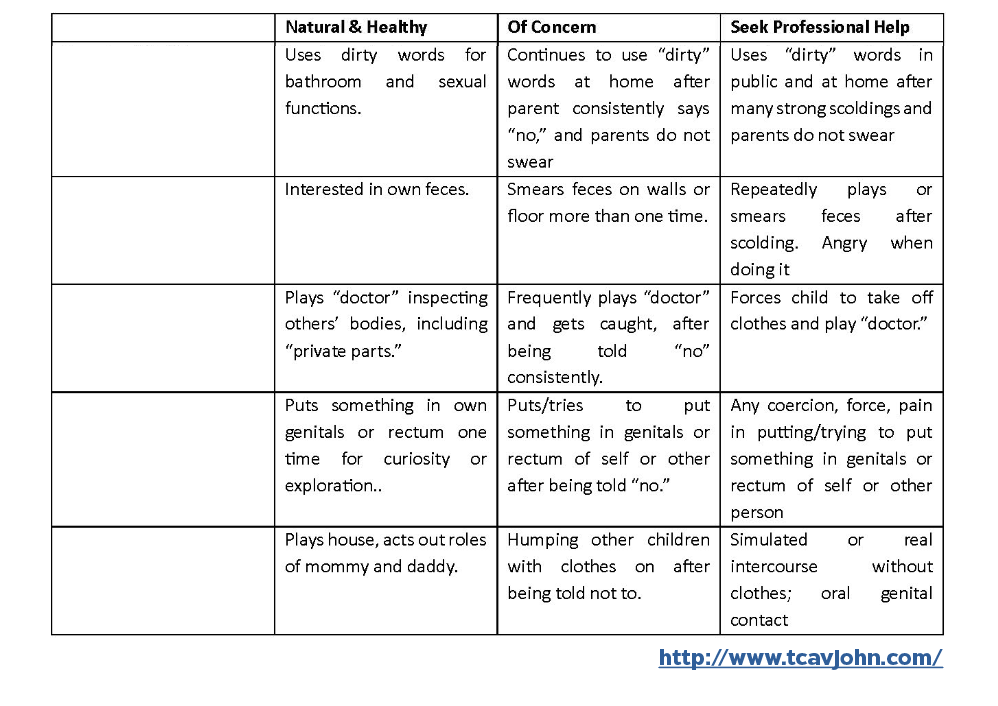
A Guide to Sexual Behaviors of Children
The information in the charts below is a way to understand children’s behaviors related to sex and sexuality in pre-school children. It is reprinted with written permission from the author, psychologist Toni Cavanagh Johnson, PhD. The following charts identify sexual behaviors of children that are natural and healthy, sexual behaviors that are of concern, and sexual behaviors that require immediate consultation. Dr. Johnson has studied and written about children’s sexual development since the 1990s. She cautions parents, however, that this guide cannot be used to determine whether or not a child has been sexually abused, and that when assessing the seriousness of a particular behavior found within these charts, it is important to consider where the behavior has taken place, how the behavior was discovered, and the relationship between the children who were involved in the behavior.
A range of sexual behaviors by age is described in each column of the following charts:
- Natural and Healthy – These behaviors are within the expected normal range for children of this age and developmental level. Children may engage in a few, several, or none of the behaviors.
- Of Concern – These behaviors are seen in children who are overly concerned about sex and sexuality for their age and developmental level. Consultation with a professional is recommended if a child demonstrates several of these behaviors or if the behavior persists despite interventions.
- Seek Professional Help – These behaviors require immediate consultation with a professional because they are indicative of a child who is experiencing confusion in the area of sexuality and is not responding to interventions by adults.
Responding to a Child’s Sexual Behavior
- Do not overreact. Do not yell. By staying calm, your child will less likely feel shame and therefore develop a healthier sense of self and view of sexuality.
- Try to figure out what happened. By staying calm, this will help you think clearly and make better decisions about what to do/say. Use open-ended questions that start with what, who, where, when, and how. Leave out the “why” questions. Separate the children involved to ask your questions.
- Stop the behavior. If children are masturbating in public or in front of others, explain to them that it is not appropriate to touch their private parts in public and that if they feel they need to touch their private parts, they need to do it in private, hence “private parts.” Children should not be told that it is “bad,” “dirty,” or “nasty” when found masturbating, and they should not be punished. When children are exploring their sexuality with other children, parents should explain to them that when they are playing with their friends, they need to leave their clothes on and that it is not okay to touch or show private parts. Parents should also ask the children if they have any questions and be available to answer any that they ask.
- Educate the child. If you encounter a situation where the child is embarrassed but otherwise not distressed, use it as an opportunity for teaching the child about healthy boundaries and rules about sexual behavior.
- Do not ignore the behavior. Believe it or not, young children can receive pleasure when their private parts are touched by themselves or another person. Sometimes children seek out other children for sexual stimulation if they have experienced the feeling in the past. This is referred to as “sexually reactive behavior.” A child is more likely to repeat a sexual behavior if the behavior goes unnoticed, is not reported, or is ignored. If you’re not sure what to do, seek out a therapist who is experienced in children’s sexual behaviors.
In conclusion, it is important to know that children at various developmental stages engage in sexual behaviors from normal/healthy ones to abnormal ones. As a parent, you want to respond to any sexual behavior of a young child, not to punish them but to educate them about boundaries and private parts.
Submitted by Lynn Willard LCSW, LSOE