
The third and concluding section of this three-part series will focus on a child’s normal and abnormal sexual behaviors for school-age children (First grade through Middle School). Like Part II, this article will provide parents with a guide to help them determine if a child’s sexual behaviors are normal and expected or problematic. This guide is intended to help parents and caregivers; however, every child is unique. Some children may begin to exhibit sexual behaviors earlier than others, given the large amount of social media available to many children, pornography, and other inappropriate material some children view. If a child has been a victim of sexual abuse and not received treatment, they are at risk for developing problematic sexual behaviors.
- Gain knowledge of children’s sexual behaviors;
- Respond appropriately to a range of developmentally appropriate and inappropriate sexual behaviors;
- Determine if the child’s behavior is normal curiosity or an indication that professional help should be sought.
Once children enter grade school (approximately ages 6–12), their awareness of social rules increases, and they become more modest and want more privacy, particularly around adults. Although self-touch (masturbation) and sexual play continue, children at this age are likely to hide these activities from adults. Curiosity about adult sexual behavior increases—particularly as puberty approaches—and children may begin to seek out sexual content in television, movies, and printed material. Telling jokes and “dirty” stories is common. Children approaching puberty are likely to start displaying romantic and sexual interest in their peers. Although parents often become concerned when a child shows sexual behavior, such as touching another child’s private parts, these behaviors are not uncommon in developing children. Most sexual play is an expression of children’s natural curiosity and should not be a cause for concern or alarm. Typical childhood sexual behaviors generally:
- Occur between children who play together regularly and know each other well
- Occur between children of the same general age and physical size
- Are spontaneous and unplanned
- Are infrequent
- Are voluntary (the children agreed to the behavior, and none of the involved children seem uncomfortable or upset)
- Are easily diverted when parents tell children to stop and explain privacy rules
Some childhood sexual behaviors indicate more than harmless curiosity and are considered sexual behavior problems. Sexual behavior problems may pose a risk to the safety and well-being of the child and other children. The longer the problem goes undetected, the more difficult it is for the child to know how to stop the behavior. For children that have been sexually abused at a younger age, not received treatment, and are now engaging in problematic sexual behaviors with other children or adults, their sexual behaviors are referred to as “sexually reactive behaviors,” and it is strongly recommended that these children receive a professional assessment and treatment as soon as possible.
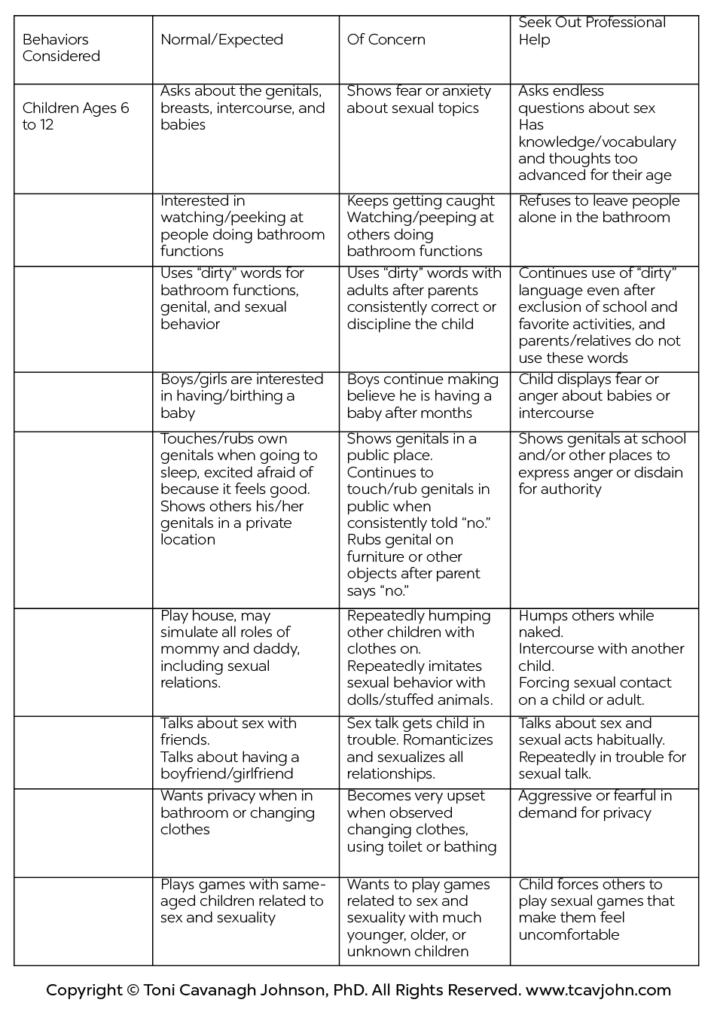
Using Toni Cavanaugh’s breakdown of children’s sexual behaviors for 6–12-year-olds as “natural and expected, of concern and seek professional help,” one can more easily understand that not all sexual behaviors in children are abnormal or problematic.
In conclusion, it is normal and expected for children to exhibit sexual behaviors from the time of birth. However, the range and scope of children’s sexual behaviors are diverse. Children’s knowledge of sexual behaviors comes from many different places: their own individual experiences, social media, pornography, and friends and parents, to name a few. Hopefully, with a little more knowledge on a parent’s part about what is normal and what is abnormal child sexual behavior, a little more conversation with children about sexuality, and less freaking out when parents observe their children engaging in sexual behaviors, children will have a better chance of growing up with a healthy view of their sexuality. The key to success, parents, is to know when to intervene and get help for your child. Most of the time, when kids engage in sexual behaviors, they are just being sexual beings too in their age-appropriate ways.
Submitted by Lynn Willard LCSW, LSOE